

The Erdős Gap
Your answer already exists. You just can't find it.

In October 2025, mathematicians found solutions to three times as many problems as usual. Twenty-three of Paul Erdős’s famously stubborn challenges, some unsolved for decades, suddenly fell. The twist: the word “found” does a lot of lifting here.
On the webpage erdosproblems.com, there are 1111 challenges proposed by the great mathematician. Problems that, in his words, “have thwarted the efforts of the best mathematicians for many decades”. Solving one is a badge of honour, to say the least.
On average, fewer than seven problems per month are marked as solved, but October 2025 was different. It saw 23 problems closed. And in the first 9 days of December, as I write this, nine more have fallen: more than a typical month, in just nine days.
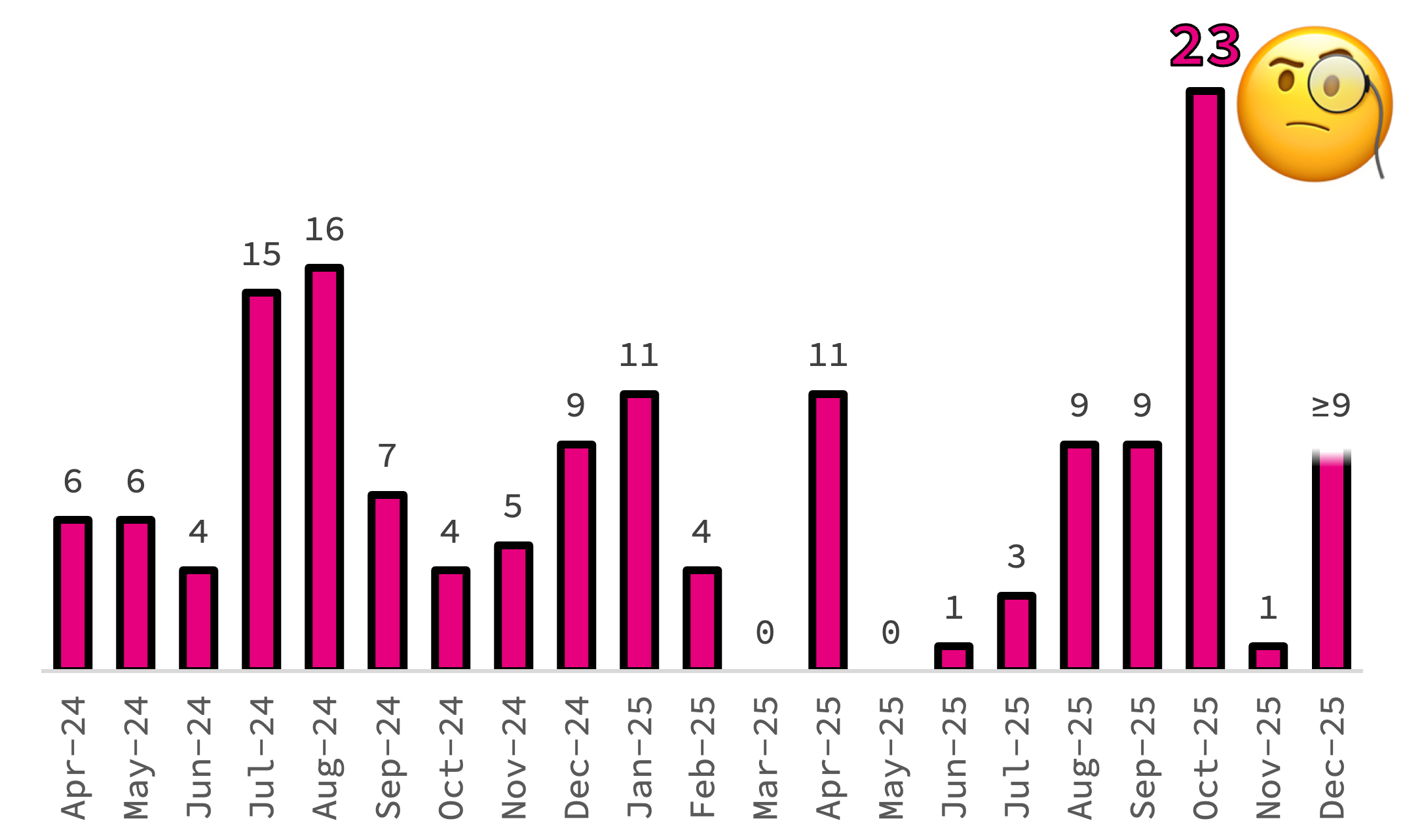
What’s happening? According to Terence Tao, an Australian-American mathematician, one of the greatest minds in the field right now, almost a dozen problems in October were marked as solved after AI tools helped locate existing solutions. Solutions that almost no one was aware of or was able to link to Erdős’ problems. The problems were not “solved” the way we normally understand the word. They had been solved, but no one noticed. Perhaps even the authors of the solutions didn’t realise that their work addressed a problem on Erdős’ list.
My untrained eye sees the same pattern in December 2025. Take problem 94, marked as solved on December 5th. The solution? A 1995 paper by Lefmann and Thiele. Sitting in the literature for thirty years. The comment that finally linked it to Erdős’ list came from a user named Boris Alexeev, who noted: “These references were located by ChatGPT.”
Erdős’ problems reveal the bottleneck: there aren’t enough minds to sift through papers from obscure journals or neighbouring fields. It’s also a “many-to-many” problem: an obscure paper might contain a solution that cracks one problem and chips away at others. And a particular problem might benefit from multiple partial solutions scattered around various papers that, when brought together, provide a breakthrough.
Tao describes this as a long tail problem. A few famous conjectures get most of the attention. But there’s a long tail of problems receiving less attention, and many are potentially easy to solve, or already solved elsewhere. AI is helpful here because it can work at scale: matching meaning rather than just keywords, shortlisting potential solutions, surfacing papers from adjacent fields, and connecting problems to answers that humans would never have time to find.
The Erdős Gap
The solutions exist, you just can’t find them. And this isn’t unique to mathematics. You’ve probably done this yourself: spent twenty minutes solving a problem, then remembered you’d already solved it months ago: the answer buried in an email thread you’d completely forgotten. It’s the professional equivalent of buying new socks because you can’t find the matching pair. Now multiply that across a thousand employees, ten systems, and five years of accumulated knowledge.

Drug Repurposing: Thousands of approved drugs might treat conditions they were never designed for, but connecting them requires reading across fragmented literature. Viagra was a failed heart medication. Thalidomide was marketed as a safe sedative in the 1950s, until it caused severe disabilities in over 10,000 children and just as many lost pregnancies. Decades later, it became a treatment for blood cancer.BenevolentAI used machine learning to identify baricitinib (a rheumatoid arthritis drug) as a potential COVID treatment in early 2020, before clinical trials confirmed it worked.
Patent Portfolios: Large companies sit on tens of thousands of patents they don’t actively use. IBM holds 150,000+. Somewhere in there is probably the solution to a problem IBM is currently spending millions to solve. Imagine the potential of many-to-many search: the many problems others have, against the many solutions in the IP registries (hello, the commercialisation team at my university, let’s talk!).
Internal Knowledge Silos: Imagine a global organisation, in which the Sydney office solved a customer onboarding problem three years ago. And the Singapore office is still struggling with it. The solution exists in a Confluence page nobody outside Sydney has ever seen. I remember we had a similar system at one of my previous employers. The joke at the time was that if Saddam Hussein had weapons of mass destruction, he should have uploaded them into the system. No one would ever find them. This is the Erdős problem at enterprise scale—many-to-many, scattered across systems, no one connecting the dots.
A few years ago, my team worked with a large government department in which individual divisions solved a specific problem. Still, other divisions, with precisely the same issue, weren’t aware. People talked, but they never realised they were using different terms (division-specific language) to describe the problem. This is where AI excels: matching meaning, not just keywords.
Where the Erdős Gap hides
Honestly? It’s everywhere. It’s in businesses that use multiple systems to store documents (“G-drive”, OneDrive, Confluence, SharePoint, and Notion in one office, anyone?). It’s in organisations that never mine their support tickets: there are solutions there, not just complaints. It’s where different teams use different words for the same problem.
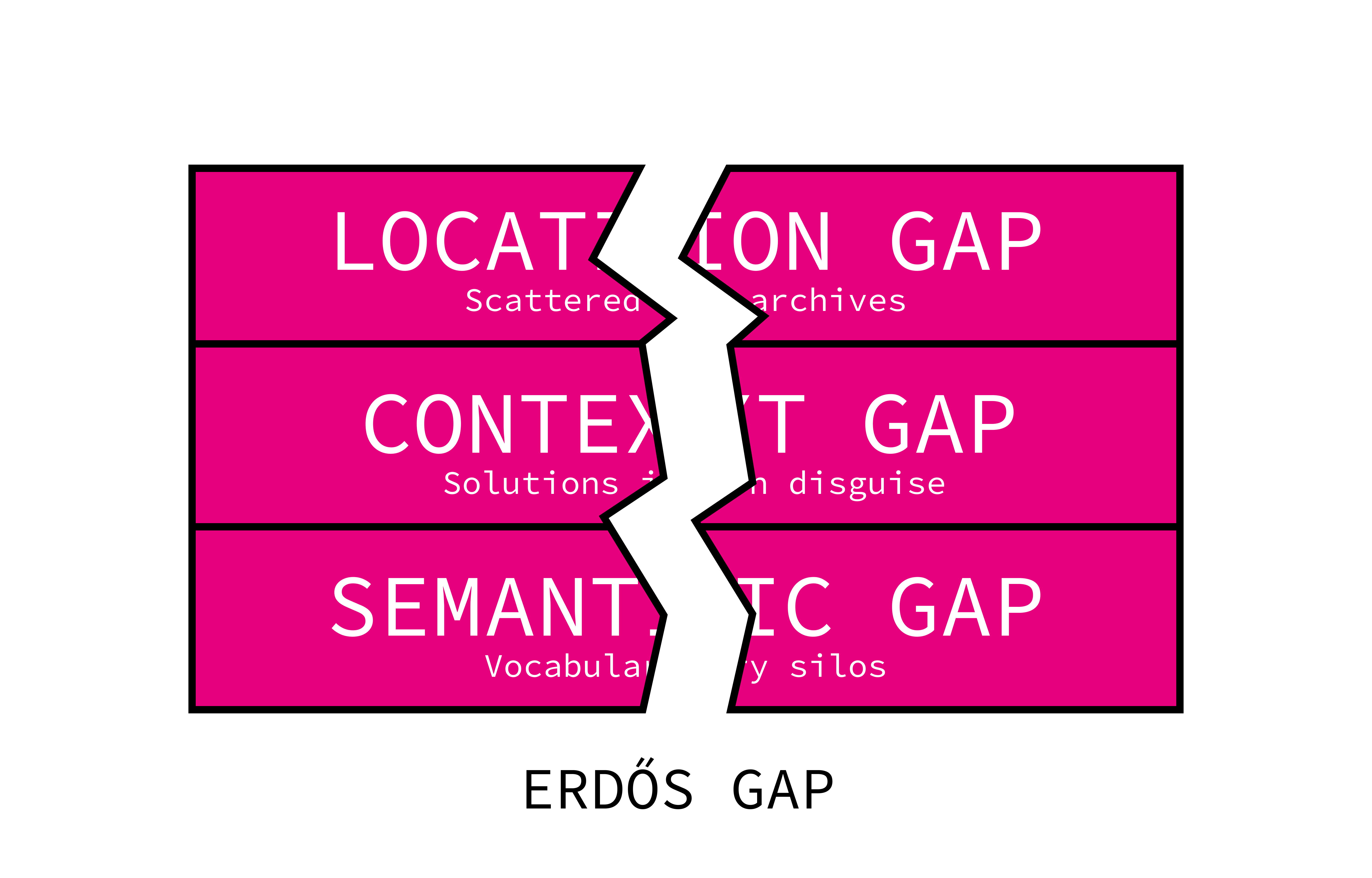
Look for scattered archives, solutions in disguise, and vocabulary silos: location gaps, context gaps, and semantic gaps. The three signatures of an Erdős Gap.
Where in your business do you suspect the answer already exists, but, if it does, finding it costs more than re-solving it?
Before you commission another research project, ask the Erdős Gap question: Has someone already solved this? To “find a solution to a problem” might simply require what the phrase suggests: finding one that already exists.
And that’s precisely the kind of nut AI is starting to crack.
That was my favorite read this week. Wild to imagine how many answers already exist, just siloed in a different scientific circle. Thank you for sharing!