

I Think Horoscopes Are Stupid
So I built an app that blames Mercury for your problems

I think horoscopes are stupid.
So earlier today, I built an app that blames Mercury for your forgotten emails (or whatever went wrong).
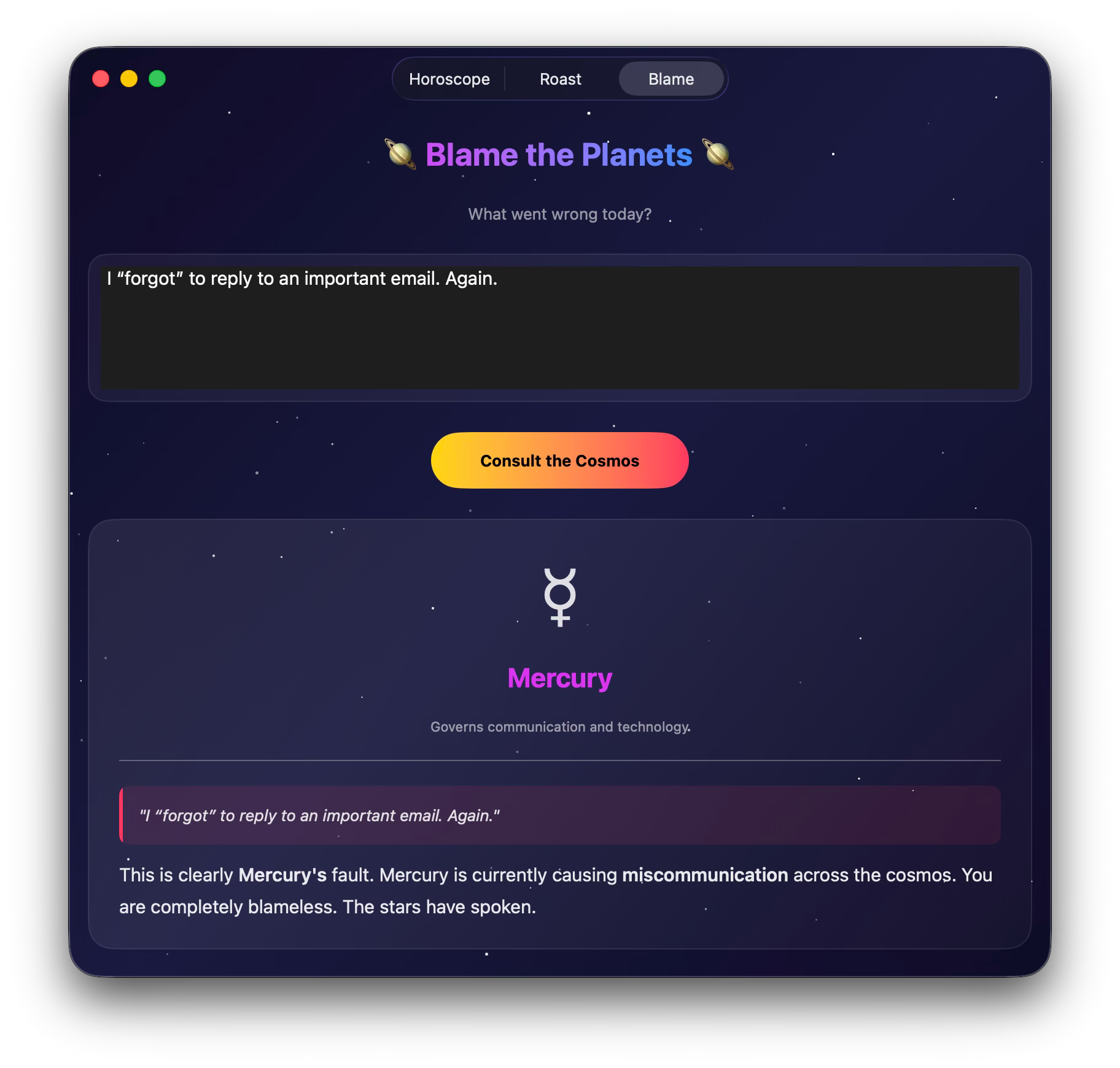
It also roasts you based on your star sign.
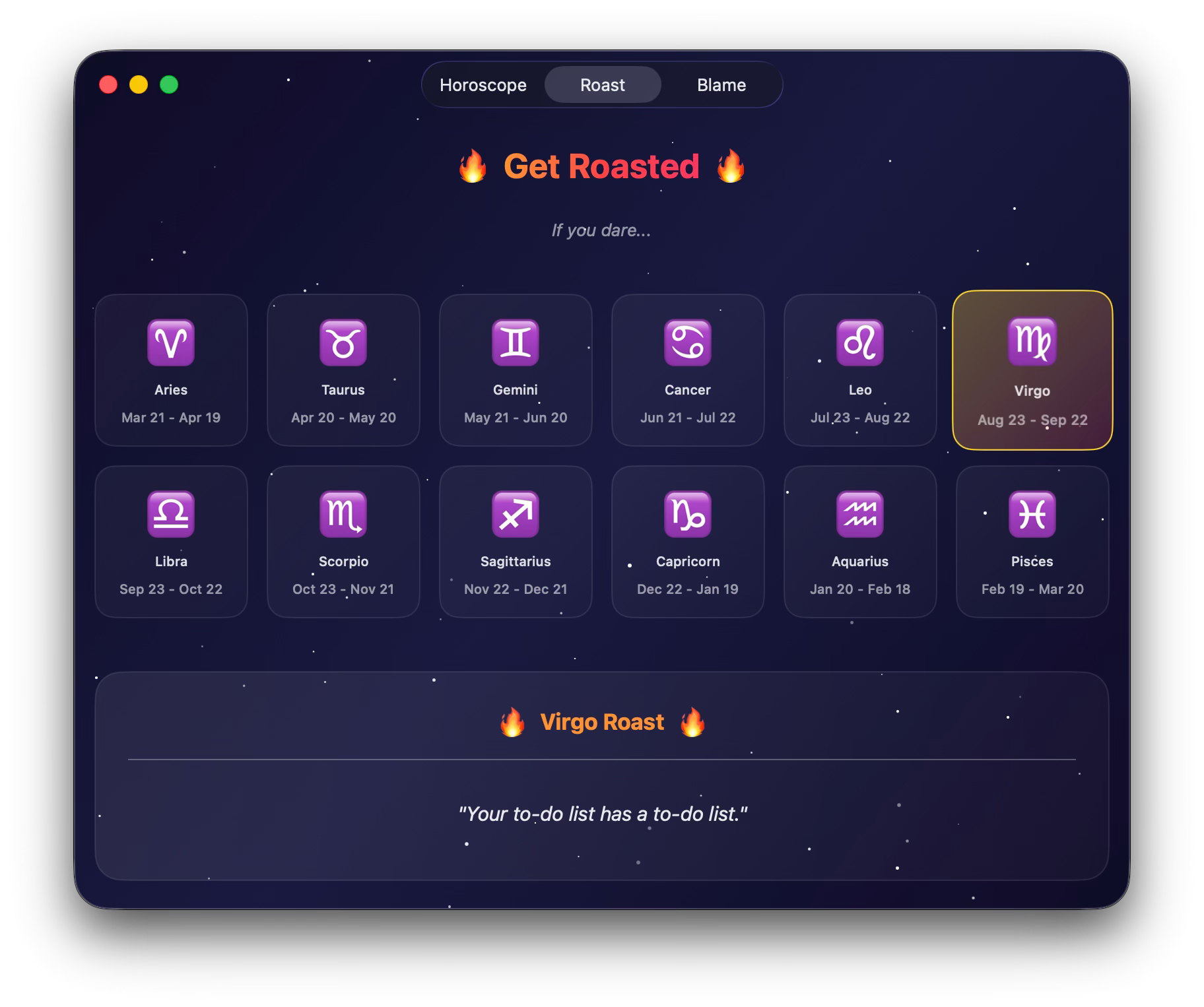
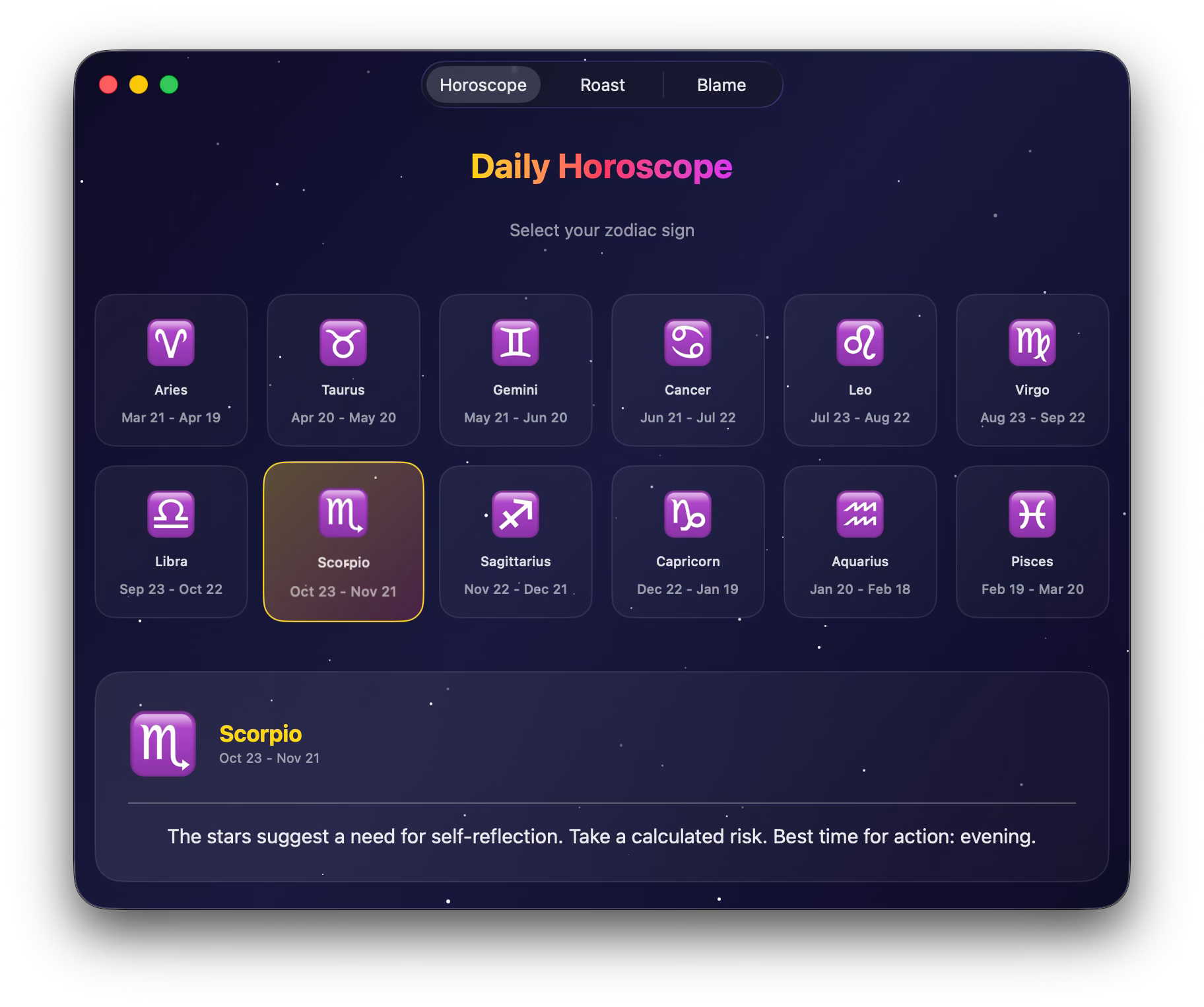
The app exists because I wrote “Create an app that writes horoscopes” into a terminal. Forty minutes, and about a dozen prompts later, I had a native macOS application with animated starfields, tabbed navigation, and a “Consult the Cosmos” button.
Not really “forty minutes”, though. It was all happening mid-air: I am en route to Davos as I built the app and write this post. Every few minutes, the terminal window would pop up, and I would have to read the response and add another prompt. Real-time commitment? Not more than five minutes.
My qualifications for building this: I once knew the programming language Python. My skills are now very, very rusty. I tried to learn another one, Swift, years ago, but lost interest. And I’ve always thought JavaScript wasn’t a real language.
None of that mattered.
Disposable Software
Think of a disposable camera. No settings. No zoom. No expectations of quality. You bought it for a wedding, shot 27 photos, and threw it away. “If it works, it works.” Nobody expected art. And yet, disposable cameras created their own aesthetic. Teenagers now hunt for them specifically because of the grain, the light leaks, the imperfection.
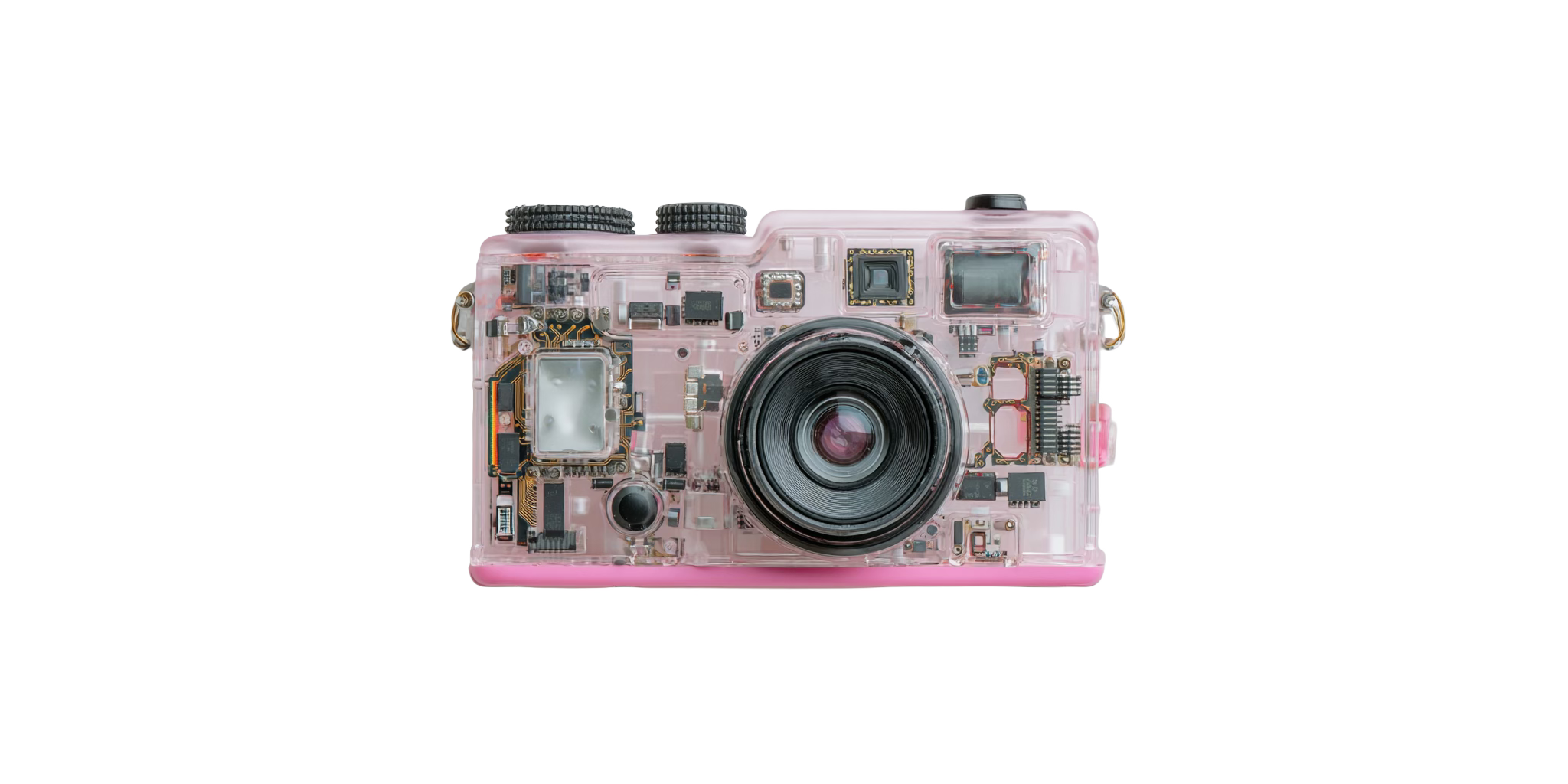
That’s what’s possible with software now. Disposable software. Built for one occasion, one person, one problem. Not meant to last. But good enough for when it’s needed.
My horoscope app isn’t meant for millions. It’s meant for me. Audience of one. I’ll probably use it twice, laugh, and forget it exists. That’s fine. It cost me nothing but a few minutes and a conversation. While everyone laments about skill atrophy when using AI, I had the opposite - the opportunity to refresh some of my coding skills. Without AI, I wouldn’t even be thinking about it.
How I built it
I am still learning Claude Code. I installed it yesterday. So, this is probably not as sophisticated as this could be, but my conversation went roughly like this:
“Create an app that writes horoscopes. In Python, I guess?”
In response to it, Claude Code created a working Python app. It was very simple, with an interface similar to text-based role-playing games in the 1980s. So I wrote:
“I would love to have a GUI. Something fancy. I don’t need it to be in Python. You tell me what to do.”
I wasn’t sure what the best approach would be. So I gave this underspecified instruction. It created a dynamic webpage: HTML with a bit of JavaScript. Animated starfield. Tabbed interface. But I wanted something more polished. Initially, I thought about building an iPhone app, but I would need to download iOS simulator to my computer, and there was no chance of it while flying - the connection was too slow.
“Let’s start with a macOS app.”
Claude Code created an application in Swift. Professional-looking result.
I didn’t learn three languages (Python, JavaScript, Swift). I had one idea that got expressed in three different formats. I specified the outcome I needed; the AI chose the implementation. The only time I specified a language was in my first prompt (“In Python, I guess?”).
At one point, I typed:
“Improve this app in a way I couldn’t predict.”
I used to manage teams of developers. That’s not something you’d say to a developer unless you know them very well. Some developers hate this level of ambiguity, in some projects this would cause a massive risk of overrunning the project budget. Not here. In a couple of minutes, Claude added ASCII art constellations, a roast mode, and the “blame the planets” feature. None of which was in my head.
What shouldn’t be disposable
Now, not everything should be built this way. I’ve used spaced repetition software since I was a high school student: apps like SuperMemo and Anki, where your learning is scheduled many years into the future. Those need trust measured in decades. I’d never let AI generate something I depend on that deeply. At least not just yet.
But a lot of software isn’t like that. A lot of software is a tool you use once, for one job, and never think about again. A script to clean up a messy spreadsheet. A quick visualization for a single presentation. A horoscope app that exists because you were curious whether you could build one.
Disposable software. For an audience of one. Built in the time it takes to describe what you want.
Will we ever hunt disposable software for its aesthetic, the way teenagers hunt disposable cameras for the grain, or the blown-out faces against pitch-black backgrounds? Probably not. Software is meant to be functional, not a piece of art (challenge me on that, I’m curious). But the aesthetic might not be in the artifact; it might be in the freedom. Disposable cameras let people shoot without being precious. Disposable software lets people build without commitment. The grain isn’t in the code. It’s in the permission to try.
I’m at the World Economic Forum in Davos this week. Speaking, moderating, attending sessions, connecting, and reconnecting. Last year, everyone talked about agents.
This year, I’m wondering: if anyone can talk software into existence, what becomes the scarce skill? What will be the theme of the year in 2026?
I’ll let you know what I find.