

Substitution, Augmentation, Activation
Recent headlines say that AI is more expensive than humans. Should we believe that?

There’s a new AI narrative emerging, and I am sure you’ve noticed it too.
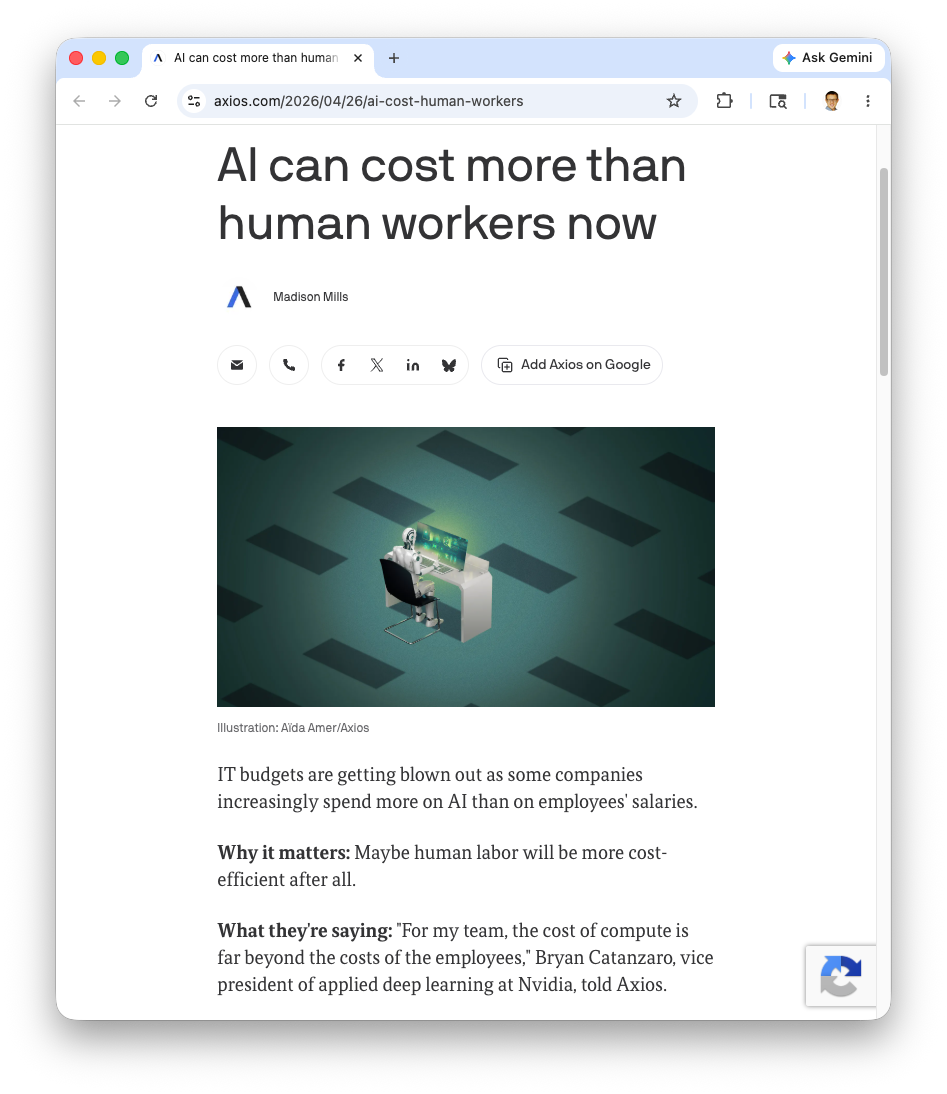
You’ve seen the headlines. Axios in April: human labour might be more cost-efficient than AI after all, citing Nvidia’s VP of applied deep learning. Fortune last week: Microsoft has discovered that “using the tech is more expensive than paying human employees.” A LinkedIn cottage industry has sprung up around these stories, each post a small exhale of relief: maybe the AI isn’t coming for us, maybe the spreadsheet doesn’t work, maybe we can go back to how things were.
I understand the appeal. I don’t believe the argument.
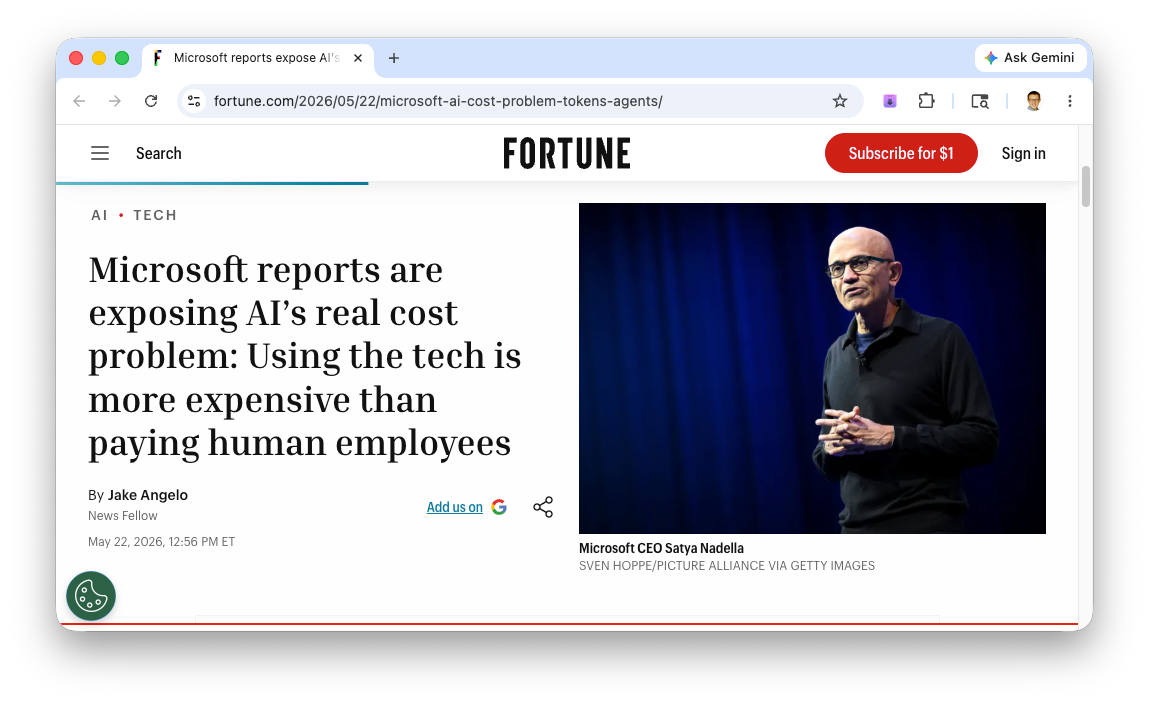
Both headlines misinterpret their source material.
Bryan Catanzaro at Nvidia said his compute bill exceeds his team’s salaries. Of course it does! Catanzaro runs the deep learning team at the company that makes the chips. My local water utility spends more on infrastructure than on plumbers. But nobody concludes that plumbers would be cheaper than pipes at delivering water.
The Microsoft interpretation is strange, too: their engineers used Claude Code so much they blew through the budget (Token Olympics, I wrote about the issue before). So, the company is moving them to a cheaper tool. That’s not “tech is more expensive than paying human employees”. That’s “some tech is more expensive than other tech”.
I am annoyed at this portrayal. It is irresponsible. Somehow, it instils a false sense of security in people.
But the deeper problem isn’t the misreading. It’s the category error underneath.
The three ways AI impacts work
AI does three different things to work, and without understanding that, we will keep making the same mistakes that Axios and Fortune made.
Substitution: when AI does what a human used to do, it substitutes the human. A junior associate would have been in charge of drafting emails, now it’s AI. Mass translations, previously performed by humans, now it’s AI (I’ll get heat from LinkedIn translators for that one: they always disagree with me on this). Or a basic customer query: answered now by AI. This is the only mode in which “Is AI cheaper than humans?” makes sense.
Augmentation: when AI helps a human do work they were already doing. Better, faster, with fewer errors. The Microsoft engineers from the Fortune article - they are augmented with AI, not replaced by it. Same with radiologists who use AI to interpret scans. And even lawyers, responsibly (of course!) drafting their submissions. In the augmentation mode, human still does the work, and AI is a tool, a tool that will likely not be replaced by a human. Just like excavator operators will likely not ask for a team of shovel-wielding diggers instead of the machine. Cost questions here aren’t human-vs-AI questions. They’re tool-vs-tool questions. “Is Claude Code worth more than Copilot?” Not “Is Claude Code worth more than a human?”
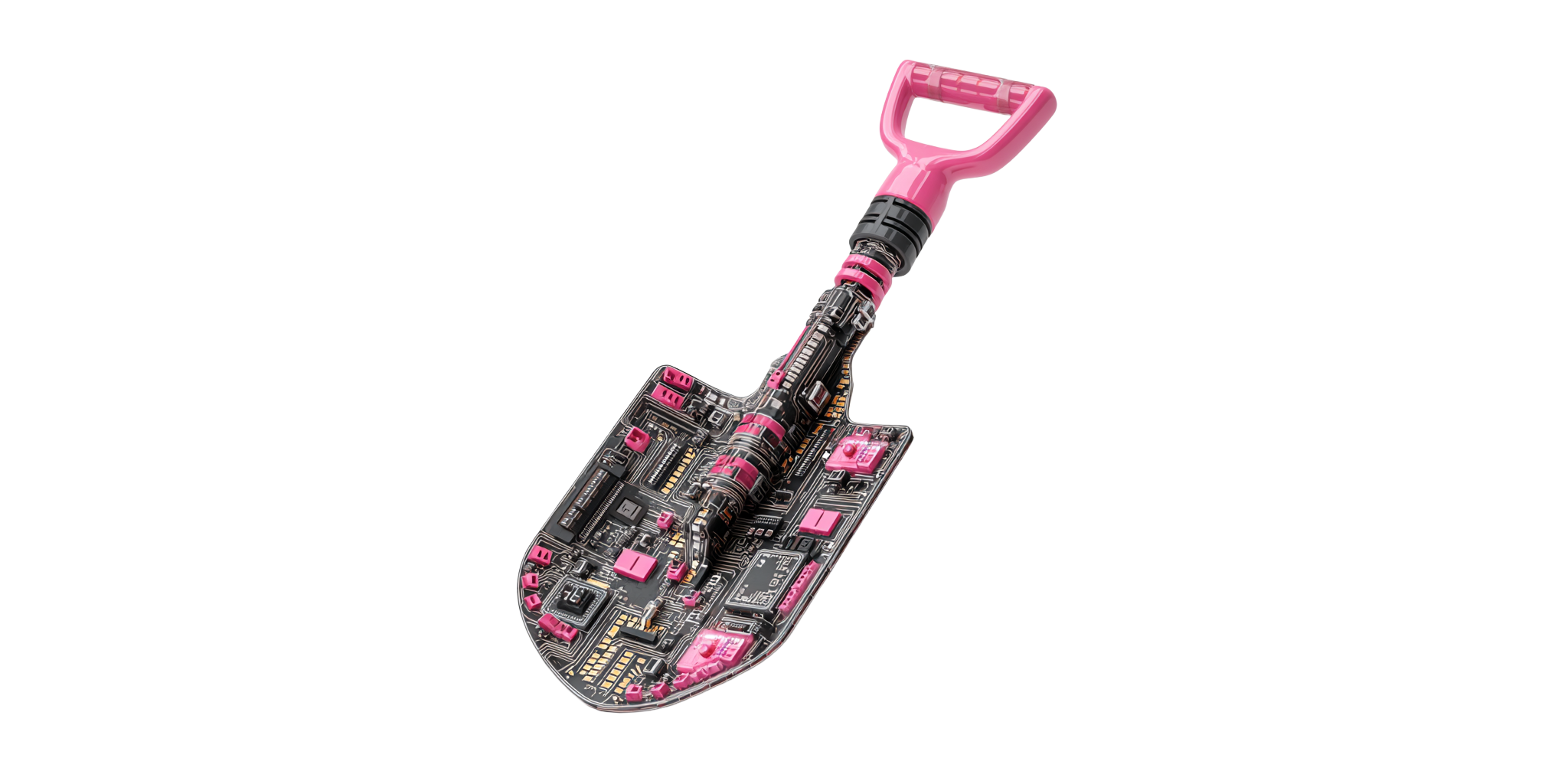
Finally, Activation: when AI does work that humans were never going to do. AlphaFold doesn’t replace (or substitute) protein folders - there were no human protein folders at that scale. Real-time fraud detection across billions of transactions is neither substitution nor augmentation. It’s a new capability, activated by AI. Catanzaro’s AI systems are the same - the engineers aren’t an alternative to more GPUs (the way shovel-diggers could be an alternative to an excavator) - it’s simply impossible for humans to ever reach the speed, scale, and possibly quality of machines.
My point? Almost every “AI is more expensive than humans” headline you’ve read this year is reading an activation case as substitution, or an augmentation case as substitution. The actual “are humans cheaper than AI?” question only makes sense inside substitution.
What might matter more than cost
Earlier this month, I sat with senior partners at a Big Four audit firm. They are redefining their business. “Time-and-materials” costing is dying, and clients now demand AI in the work, sometimes as a condition of engagement (I was genuinely surprised to hear this).
We kept going back to the same question: how do we measure whether the work is any good? (Regardless of whether it is human work or AI agent work).
Their entire industry was built on the assumption that humans did the work and humans were trusted to do it well. They never had to define, precisely, what “adequate” looks like, because the workforce, the quality of their people, was the definition. Now they’re being asked to substitute, and the substitution has raised a new question: how good does this work need to be to be acceptable?
We have had many examples of AI producing inadequate work. Klarna’s long list of unhappy customers forced them to limit their AI chatbot and bring humans back. When Air Canada lost its tribunal case over its chatbot’s hallucinated refund policy, the same thing. The McDonald’s drive-through experiment, same thing.
The cases where AI is genuinely more expensive are almost never substitution cases. They’re activation cases (where comparing to humans does not make sense) or augmentation cases (where the human is still there). The substitution cases that fail, like Klarna, Air Canada, and the McDonald’s order screen, most often fail not on price but on adequacy.
Your Monday to-do
Pick one task your organisation has discussed deploying AI for.
If it’s a substitution case, write down what adequate means for that work, and figure out how you’re going to measure it, to confirm whether the substitution makes sense.
If it’s augmentation, don’t compare the output to humans; the question is which tool it is, what your people produce with it, and how it would compare to other tools (think: an excavator versus a bunch of shovels, or maybe another excavator).
If it’s activation, stop pretending there’s a human baseline at all. Comparing the compute bill to salaries is silly. Focus on the actual cost-versus-value calculation.
If you’re a worker, the implications are harder, and I’ve written about them elsewhere. The short version: you can’t price-compete with AI on any task where AI is adequate.
The audit partners I sat with knew they had that question. Most leaders haven’t realised they have it yet.