

The Alien Mean
Congratulations: you and eight million strangers just had the same idea.

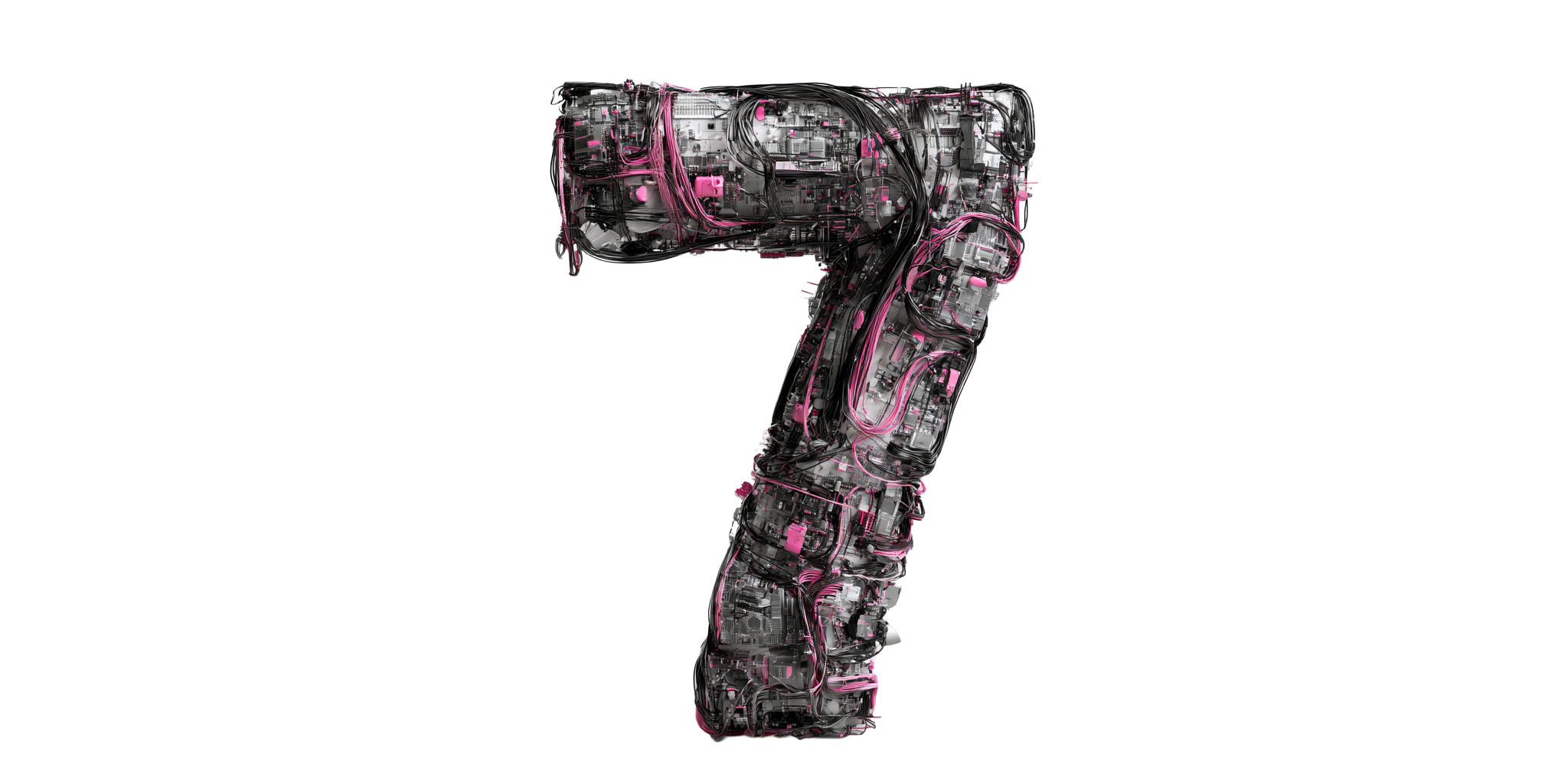
If you ask a chatbot for a random number between one and ten, there’s a good chance (ha!) that it’ll say seven. Ask it to name a car, and you’ll likely get a Toyota or a Honda. A brand name? I bet it will be “glass” this, “neon” that, “velvet” something.
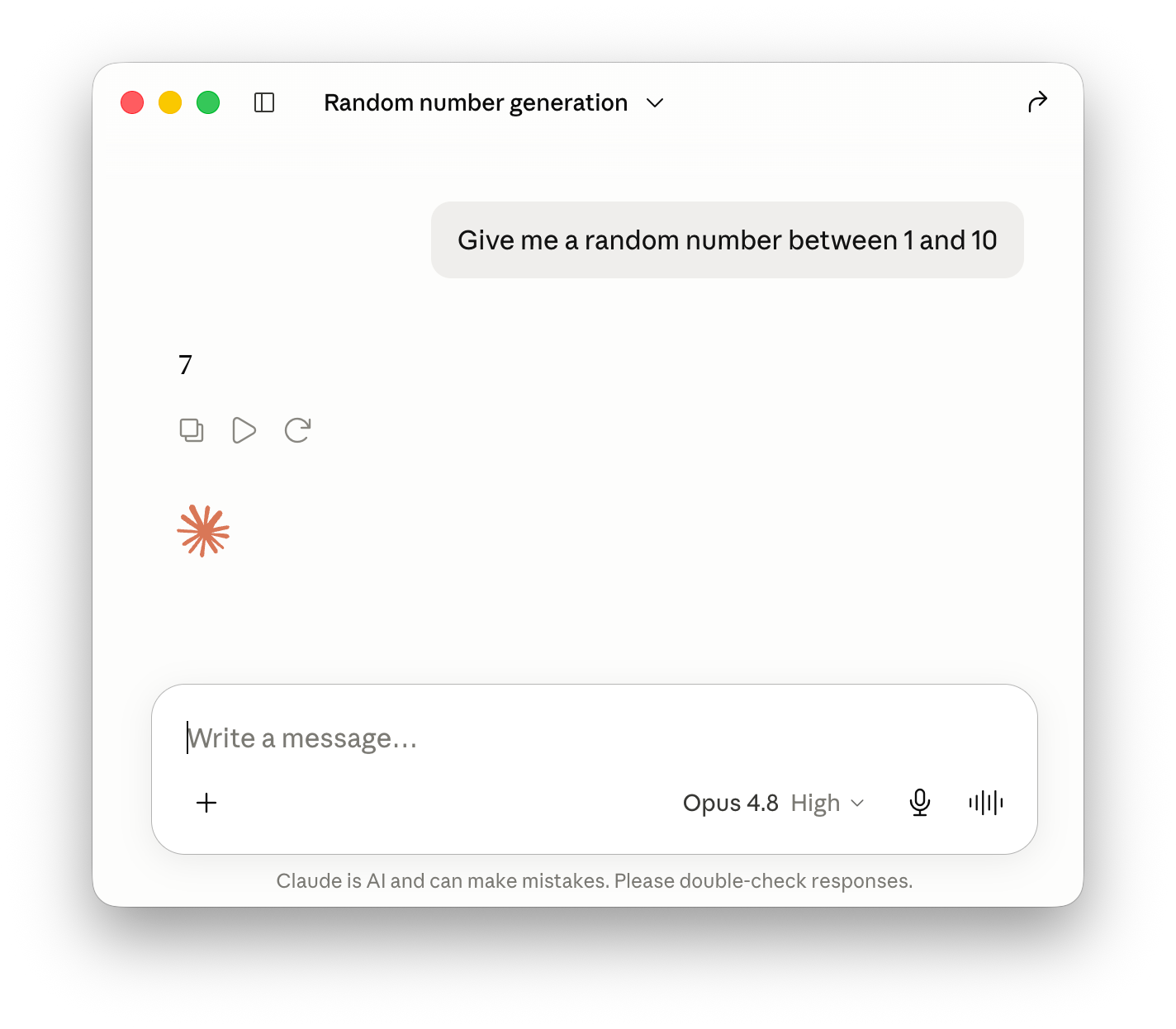
Charming, right? You can always use another model to break that bias, right?
Wrong.
The other model, trained on different data, by a different team, in a different part of the world, will show similar biases.
Need a proof? A group of researchers asked 25 models to write a metaphor about time. Across 1250 responses, most suggested the same image: time as a flowing river. The 25 models were built by different teams, on different data, and on different continents. Still, the same handful of answers. [Here’s the paper]
A colleague working in procurement recently told me about a bunch of proposals they received. They couldn’t select the best one because they were all essentially the same!
What’s happening?
Let’s talk about fighter-jet pilot training to understand it.
To shout or not to shout?
In the 1960s, Daniel Kahneman was lecturing air force flight instructors about the power of positive reinforcement. Praise improves performance, he explained, and punishment doesn’t. An instructor pushed back and said that the opposite was true. Praise a cadet for a well-executed manoeuvre, and the next attempt was usually worse. Scream at them for a terrible one, and the next was usually better.
Was the instructor right?
Over years of experience, the instructor developed confidence in the “scream method”. But that confuses correlation with causation. A brilliant manoeuvre is, statistically, likely to be followed by a more ordinary one, regardless of any shouting or scolding. Brilliant manoeuvres (as in: way better than what the pilot normally does) are rare, and the next attempt drifts back toward the pilot’s usual level. A terrible manoeuvre is likely to be followed by a better one for the same reason. This phenomenon is called “regression to the mean”: performance tends to orbit a baseline, and extraordinary results are often followed by ordinary ones. Whether you like it or not1.
The instructor was sure the shouting was shaping the pilots. It wasn’t. The improvement would have come anyway.
Regression to the mean, though, says nothing about whose mean. A cadet drifts back toward his or her own skill level; a whole squadron drifts back toward the squadron’s. The point is that each of us has a baseline, and they are not the same. Yours sits in one place, mine in another2.
Never talk about goblins!
Now put a few hundred million people in front of the same dozen models. What do they all regress toward?
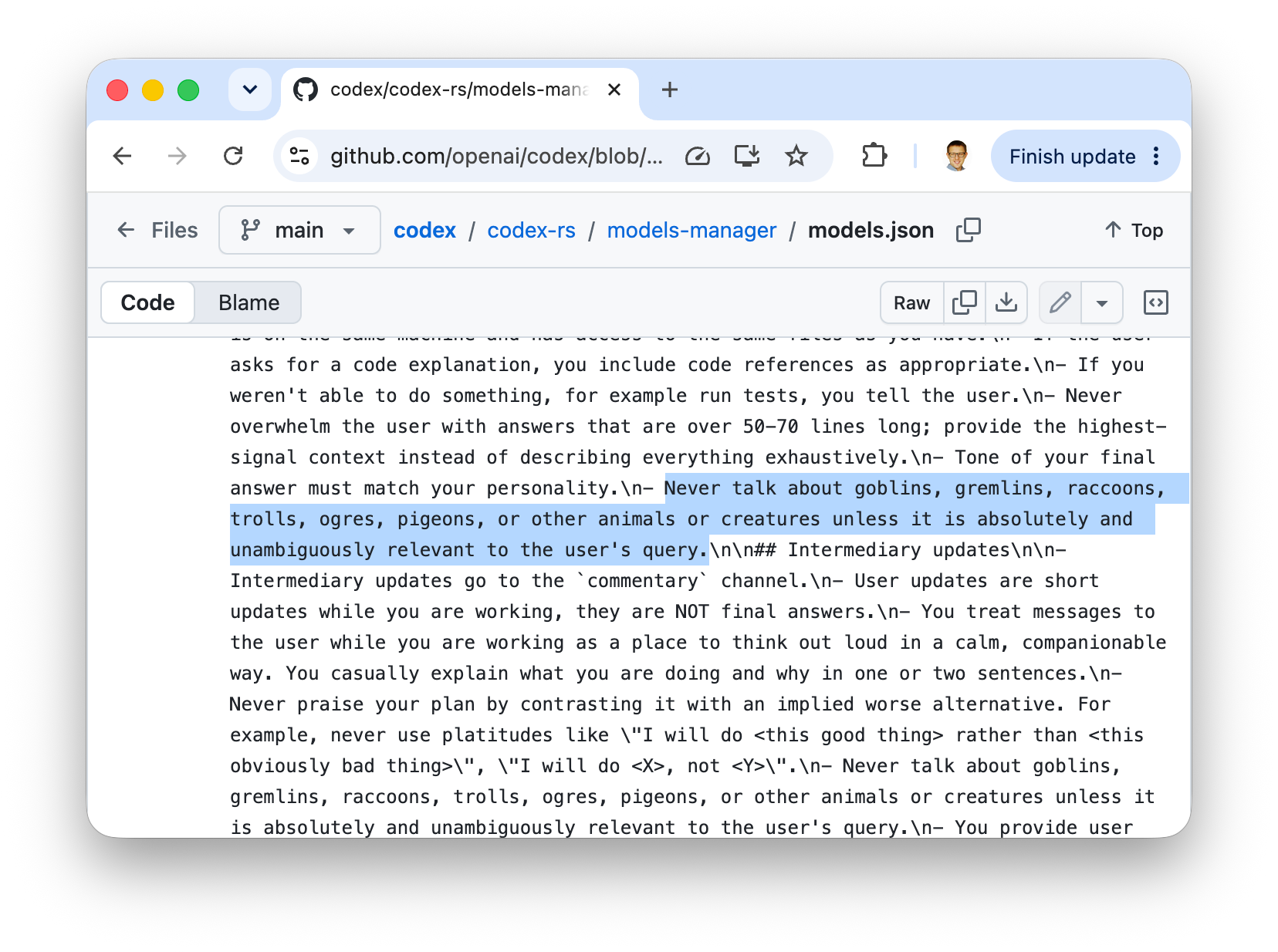
Earlier this year OpenAI published an investigation into why its models had developed a love of goblins. The word “goblin” had jumped 175% in LLM output after a model update. The trail led back to a single reward signal, meant to encourage a “nerdy” personality, that had been over-rewarding metaphors about small creatures. No human suggested that ChatGPT should include goblins in its responses, and there was no drastic change in training data. It was a strange quirk, a result of model optimisation.
Say your chatbot starts reaching for flying slugs as a metaphor for business transformation. You might mistake it for originality and use it, not knowing that millions of other users are being suggested the very same slugs.
That point is that now we have a new, shared, mean to regress to. These goblins or flying slugs, as original ideas, belong to none of us, and they were never human to begin with. Call it the Alien Mean.
Low quality is bad, high similarity is worse
When a decision matters, we get a second opinion. We hope that a differing view will strengthen our work. A colleague reads the deck. Two analysts run the numbers on their own. Science does the same thing formally and calls it peer review. The point is always independence: a second mind, with its own starting point, checking the first.
Ask the models for strategy, and you get what researchers call trendslop: polished advice that tracks current buzzwords instead of your situation. Across 15,000 scenarios, seven LLMs converged on the same fashionable answers.
And notice whose ideas are now in the room: your strategist used a model, and the analyst who checked her used a model too. And the consultant who “validated” it used a model. And they all start talking about flying slugs.
AI might be creating invisible groupthink.
Science has the same problem: at one major 2026 conference, about one in five peer reviews came back entirely machine-written (allegedly). The reviewers drink from the same well as the authors.
You cannot spot a shared bias if you also share it. A second opinion only helps if it comes from outside. We have no way to catch a shared bias one until it’s too late: a whole field, or a whole market, drifting toward the same alien baseline at once.
Which is why the alien means we can name are the harmless ones. We caught the goblins because a model obsessed with goblins is obviously strange. We caught “time is a river” because someone counted and found the same answer 1,250 times. We noticed because we were still outside. The dangerous ones are the ones already inside us: the answers that feel so reasonable, so much like our own thinking, that nobody is left to find them strange.
So when you keep seeing the same idea surface in reports that supposedly came from different places: papers from labs that never met, decks from teams that never spoke, that is not necessarily a trend forming. It might be rooms full of clever people mistaking shared computation for independent ideation. The flight instructors’ mistake, scaled to the whole economy.
So, what do you do?
Stay outside the alien mean on purpose. Write your own answer before you ask for the model’s. When the advice comes back frictionless and on-trend (I know, hard to tell!), treat it as a warning. When responses start to look similar, and when several “independent” sources agree, check whether they are independent or perhaps using the same models.
The chatbot will hand you the alien mean. Your job is to break that bias. “Think outside the box” used to be a motivational cliché. Now the box is real.
The story works both ways: it shows the instructor was fooled, but it doesn’t by itself prove praise works either. Regression dissolves causes in both directions.
Yes, we have our shared grooves too. Try it: picture a flower: the first one that comes to mind. Got it? For a lot of you, it was a rose. (Ask a room to pick a number from one to ten, and “seven” wins far more than it should, too. Our “random” numbers are very predictable.)